
Jimbochō and Beyond — Tokyo’s Book District and the Fight to Reclaim Attention | MK Deep Dive
- M.R. Lucas
- Dec 4, 2025
- 6 min read
Updated: Dec 16, 2025

The Age of Eight Seconds
In an age where the average human attention span has fallen from around twelve seconds at the turn of the millennium to just above eight today — slightly less than the nine seconds often attributed to a goldfish — dopamine-draining social media on our pocket black mirrors continues to erode our capacity for deep thought. Short curated videos zap away at consciousness, and weaponised algorithms quietly choose what enters the mind before we make any conscious decision.
Across much of the developed world, only about half of adults report reading a single book in the past year, and almost sixty percent haven’t opened one in the past month. In this climate, the sight of morning shutters lifting along Yasukuni-dōri — rows of sun-faded spines spilling onto the pavement — makes Jimbochō feel like an antidote. In this neighborhood, individuals can reclaim their mental sovereignty from Silicon Valley’s design labs and deliberately choose what they upload to their own minds.
That a district defined by aging paper and academic clutter was named the world’s coolest neighborhood by Time Out surprised many, not least longtime admirers who felt a pang of selfish loss at seeing their quiet refuge broadcast to the world. But perhaps the recognition is a hopeful omen. As society inches closer to merging permanently with its devices, Jimbochō — “book town” — remains the haunt of Tokyo’s intellectually curious: students, collectors, solitary wanderers, and those seeking depth rather than distraction.

Romanticized in spirit by writers like Ryūnosuke Akutagawa — author of “Rashōmon” — the district has long served as a literary crossroads. A visit here is more than sightseeing; it is a chance to reclaim the self. Jimbochō, located in Kanda, houses roughly 130 bookstores specializing in literature and religion, the social sciences, manga, and the occasional American comic book. The district radiates from Yasukuni-dōri, branching into a network of alleys where weathered pages, rare editions, leather-bound spines, and the scent of curry create a layered landscape.
Jimbochō rewards exploration. This guide may gesture toward a direction, but the wanderings belong entirely to the visitor. One book discovered at the right moment can alter the course of a lifetime.
Saboru: A Kissaten That Time Forgot

Late morning is the ideal time to arrive. Around eleven, shutters lift, and bookshelves spill into the street as though the inventory has outgrown its walls. An old Iraqi proverb comes to mind: “The reader does not steal, and the thief does not read.” In Jimbochō, rows of unguarded books resting calmly outdoors suggest the proverb still holds.
The day begins at Saboru, one of the district’s definitive kissaten. Open since Shōwa ’55, it embodies the charm of Japan’s mid-century coffeehouses, a world rediscovered by retro-analog-loving youth. There is no Wifi; smoking is still permitted; the atmosphere proudly resists modernity. Hidden in an alley and overgrown with greenery pressing against the concrete, Saboru feels like stumbling on a hobbit’s hideaway.
Its name, meaning “to skip” or “slack off,” fits a neighborhood orbiting universities and language schools. Inside, decades of handwritten messages climb the walls — an early, analog comment section. Over a blue melon soda and a plate of Napolitan spaghetti, both kissaten staples, visitors rediscover the rare feeling of becoming one’s own best company.
Kitazawa Bookstore: The Platonic Form of a Bookshop

From Saboru, the path bends naturally toward the shelves. Along Yasukuni-dōri, small storefronts sell vintage manga, old DVDs, and Japanese movie posters reborn as vaporwave artifacts. Up a modest staircase, Kitazawa Bookstore reveals an interior lined with aged mahogany shelves filled with English literature and academic treasures.
Founded in 1903, Kitazawa offers books that awaken the intellect, redirect a life, or challenge a worldview — works of philosophy, religion, critical theory, and classical thought. These are not the hollow distractions of suburban big-box chains filled with titles destined to evaporate upon finishing. Here, the curriculum is self-directed, an academy without faculty or tuition, built for those who still believe in the project of thinking.
Among such stacks, it feels entirely possible to stumble across Plotinus’ Enneads and feel the mind subtly reoriented toward deeper metaphysical realities. This is what Jimbochō does at its best: it confronts the visitor with the quiet possibility of transformation.
Meiji University Museum: Crime, Punishment, Memory
_20171129.jpg)
A short walk away, the Meiji University Museum presents a different archive of human experience. Its archaeological collection is rich and carefully arranged, but many find themselves drawn most strongly to the “Crime and Punishment” section — not Fyodor Dostoevsky’s novel, but actual implements of justice.
Displays trace the history of policing, trials, and punishment from the Edo period forward, including a guillotine and a reproduction of the Iron Maiden of Nuremberg. Beneath the museum’s low lighting, the exhibits feel somber rather than sensational — a reminder of both the human fragility and the endurance of civilization.
Bondy: The Monarch of Jimbochō Curry

After working up an appetite looking at tools of torture, attention returns to the body. Jimbochō is as famed for its curry as for its books, serving as the heart of the annual Kanda Curry Grand Prix. Among its many shops, Bondy holds the crown.
Hidden inside a nondescript multi-tenant building behind the main bookstore strip, you know you’ve found Bondy by the line spiraling up the stairwell. Inside, the Shōwa-era interior remains preserved — a warm glow of wooden blinds, red booths, and glass-bottle colas humming in refrigerators.
European-style curry was pioneered here in 1973 by founder Kōichi Murata, who blended the structure of French brown sauces with Japanese curry traditions. Apples, peaches, onions, tomatoes, butter, and cream form a rich, mellow, balanced roux anchored by tender cubes of beef and often topped with cheese.
The ritual begins with two steamed potatoes and a pat of house butter — a simple gesture that feels like an inherited comfort. Fukujinzuke pickles, radish, and green shiso seeds offer bright palate resets. An iced coffee cut with condensed milk often serves as the quiet finale.
More than fifty years after opening, Bondy remains Jimbochō’s culinary standard-bearer, the shop that transformed a book district into Tokyo’s curry town.
Kanda Myōjin: The Guardian on the Hill
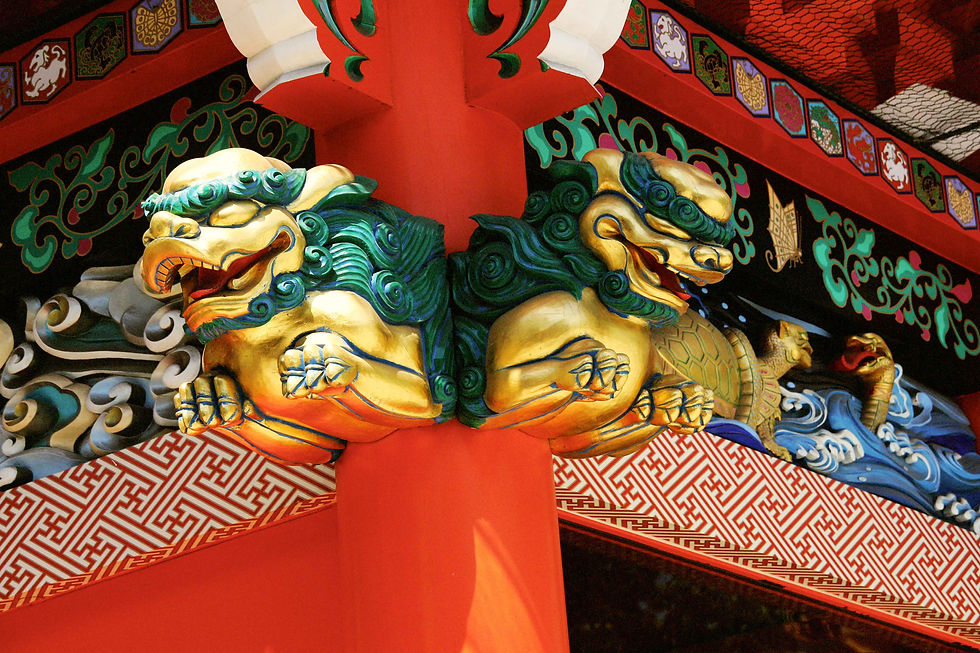
The day concludes just beyond Jimbochō’s borders. Leaving the book district behind, you climb the gentle slope toward Ochanomizu and arrive at Kanda Myōjin Shrine, which has anchored the spiritual life of this region for over twelve centuries.
Founded in 730 by a priest of the Izumo line, the shrine guards the districts of Kanda and Nihonbashi, as well as the areas that would become Akihabara and Ōtemachi. Daikokuten, Ebisu, and the restless spirit of Taira no Masakado preside here, their stories woven into the political, commercial, and spiritual development of Edo and Tokyo alike.
The shrine has burned, fallen, and been rebuilt multiple times — its current form emerging only after the devastation of 1923 and 1945. Today, office workers, families, merchants, and tech enthusiasts pass beneath its vermilion gates, leaving prayers that range from business success to digital protection charms for laptops and servers.
As the sunset deepens and lanterns begin to glow, the shrine grows quiet. Descending the hill toward Ochanomizu, a final detail frames the end of the day: the distant silhouette of St. Nikolai Cathedral rising across the skyline, its dome catching the last light of day. It’s a subtle reminder that Tokyo holds layers of spiritual history far older and more diverse than the neon districts suggest — a city where old worlds and new ones coexist along the same ridgeline.

In a world of collapsing attention spans, Jimbochō offers something rare: a full day in which thought, appetite, and spirit are allowed to stretch again.
LET MK BE YOUR COMPASS
From Shōwa-era kissaten to century-old bookstores, from European-style curry to shrines that have guarded the city for over twelve hundred years, Jimbochō invites travelers to slow down and reclaim the mind.

Let MK guide you through the alleys, shelves, and sanctuaries where Tokyo reveals its most reflective self.
M.R. Lucas is a writer living in Japan.
Image Credit
Suginami, CC BY-SA 4.0 https://creativecommons.org/licenses/by-sa/4.0, via Wikimedia Commons
"Untitled" by sito_ is licensed under CC BY 2.0.
先従隗始, CC0, via Wikimedia Commons
Kitazawa Bookstore — Image courtesy of Kitazawa Bookstore Official Website https://kitazawabook.official.ec/
Photo by M.R. Lucas
"Kanda-myōjin poutres komainu" by Hyppolyte de Saint-Rambert is licensed under CC BY-SA 4.0.
"Nikolai Cathedral" by Joe Jones is licensed under CC BY 2.0.


Comments