
Arashiyama Bamboo Grove — Beyond the Instagram Myth and Into Kyoto’s Real Atmosphere | MK Deep Dive
- M.R. Lucas
- Dec 11, 2025
- 4 min read
Updated: Dec 16, 2025

For most travelers arriving in Kyoto, the Arashiyama Bamboo Grove is already etched into their imagination long before their plane lands. Social media has packaged it as a must-visit — an immaculate corridor of green, the kind of backdrop where a lone samurai might drift through morning mist. If your mind works anything like mine (very specific), you may picture the amoral swordsman Ryūnosuke Tsukue from Sword of Doom, wandering a spectral forest before cutting down enemies emerging from the fog.
Reality, of course, is different. The grove is crowded — very crowded. Influencers have learned to crop, frame, and contort angles to create the illusion of timeless tranquility. You won’t get that version at 10 a.m. in peak season. What you will get is the most distilled amalgamation of Japanese imagery that many people fly halfway around the world to experience. And popularity alone is not a crime. We shouldn’t write off a place simply because everyone else wants to see it too. There’s a reason for the crowds.
I say this as someone who once witnessed the grove in a way almost no one today can. During the height of COVID, when tourism had evaporated, my now-wife and I rode bikes through the bamboo in complete silence. Not a single person in sight. The memory still sits with me — how the air felt charged, how the atmosphere became something impalpable, impossible to articulate. In that moment, I understood why Arashiyama has endured for more than a millennium. There is something in the air.
That said, you can still find your own quiet corner of it. The grove is open 24 hours, and with a bit of planning — sunrise, after dark, or even a rainy Tuesday — you may find it closer to the dreamy solitude promised online. Just don’t expect the crowds to disappear entirely. Expect humanity: people chasing the same fleeting feeling you are, the same momentary transcendence. There’s a strange camaraderie in that, meticulously chosen selfie-angles and all.
And please — do not carve your name into the bamboo. It’s a UNESCO World Heritage Site, not a middle-school desk.
Walking Through a Thousand Years

Arashiyama wasn’t built for tourists. During the Heian period, this was the retreat of aristocrats who came here to breathe, to wander, to escape the rigid atmosphere of the capital. The bamboo, planted intentionally and maintained over generations, framed villa gardens and temple grounds. Later, under temples like Tenryu-ji (1339), the groves supplied ritual implements, fencing, baskets, and protection from the wind. The “natural” look is a product of centuries of human shaping — subtle intervention meeting natural beauty with near-perfect balance.
That aesthetic lineage is still visible today, with sunlight filtering through towering stalks, a sprawling green tunnel that seems to breathe, yukata-clad women walking back from nearby Nonomiya Shrine, rickshaw drivers navigating the crowd with pulsing calves, and bamboo stretching skyward in near-cathedral formation.
This is Japanese tourism at peak intensity — an experience that has long surpassed the infrastructure of Kyoto itself. But none of that is the forest’s fault.
Where to Begin

For the strongest first impression, enter through the North Gate of Tenryu-ji. Step out of the Zen garden, cross the threshold, and suddenly the space opens into bamboo soaring up to 40 meters tall. Sunny days bring a natural green luminance; cloudy days darken the path into something moody and cinematic — your internal samurai film activated.
The path is shorter than most expect, but it spills directly into Ōkōchi Sansō, the former villa of actor Denjirō Ōkōchi. Make time for it. The vantage points across Kyoto are worth the slow climb.
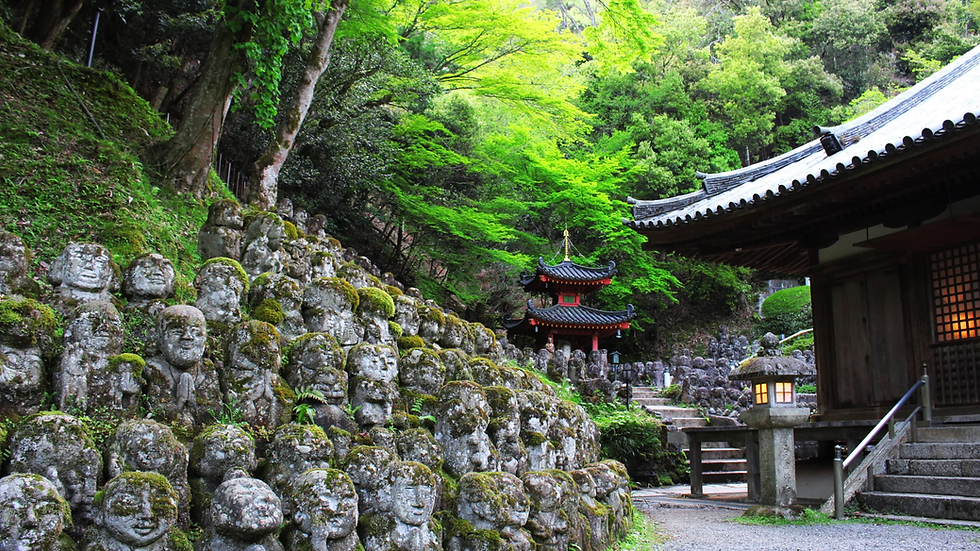
And if you venture further, the district continues to reward you: Tenryu-ji itself, a UNESCO World Heritage Site; the mountain-framed Katsura River; and even Otagi Nenbutsu-ji, criminally overlooked, with its 1,200 whimsical rakan statues watching over the hillside.
Atmosphere Beyond Logic

Arashiyama’s bamboo has been designated one of Japan’s official “Soundscapes of Japan”, and when the wind moves through the stalks, you understand why. There’s a sensation — especially at dawn or dusk — of stepping beyond the rational mind, of brushing against something transitory and transcendental. Day, dusk, and night each have their own temperament, their own emotional palette.
Bamboo in Japanese culture symbolizes purity. Imagine, even for a second, the crowds dissolving. Wabi-sabi — impermanence, beauty, quiet — is still there. It’s just layered under the present reality: a thousand people moving through a thousand years of landscape.
Visit early or visit late, but visit. Don’t chase the social-media version; chase your own. Arashiyama has always been a place shaped by humans but touched by something older than human design. Expect the crowds, let the fantasy live somewhere in your imagination, and walk the path anyway — even if every photo you’ve ever seen (including the ones here) leaves the crowds out of frame.
It has endured this long for a reason.
MK Take
Arashiyama Bamboo Grove isn’t about chasing an empty Instagram fantasy — it’s about stepping into a landscape shaped by a thousand years of human hands and quiet ritual. Yes, it’s crowded, but beneath the foot traffic is a rare blend of atmosphere, history, and aesthetic precision that has defined Kyoto since the Heian court wandered these same foothills. Go early, go late, or go in the rain, and let the mood of the grove catch you off guard. What stays with you isn’t the photo; it’s the feeling.

Let MK guide you through Kyoto’s western edge — from the meditative gardens of Tenryu-ji to the bamboo-lined paths of Arashiyama — so you can experience this iconic district with clarity, depth, and a sense of place.
M.R. Lucas is a writer living in Japan.
Image Credits:
Naokijp, CC BY-SA 4.0, via Wikimedia Commons
Zairon, CC BY 4.0, via Wikimedia Commons
Don Ramey Logan, Koi Pond at the Bamboo Forest 2, Kyoto, CC BY 4.0, via Wikimedia Commons
dconvertini, CC BY-SA 2.0, via Wikimedia Commons


Comments