
Otagi Nenbutsu-ji — Kyoto’s Forest of 1,200 Faces | MK Deep Dive
Updated: Dec 16, 2025
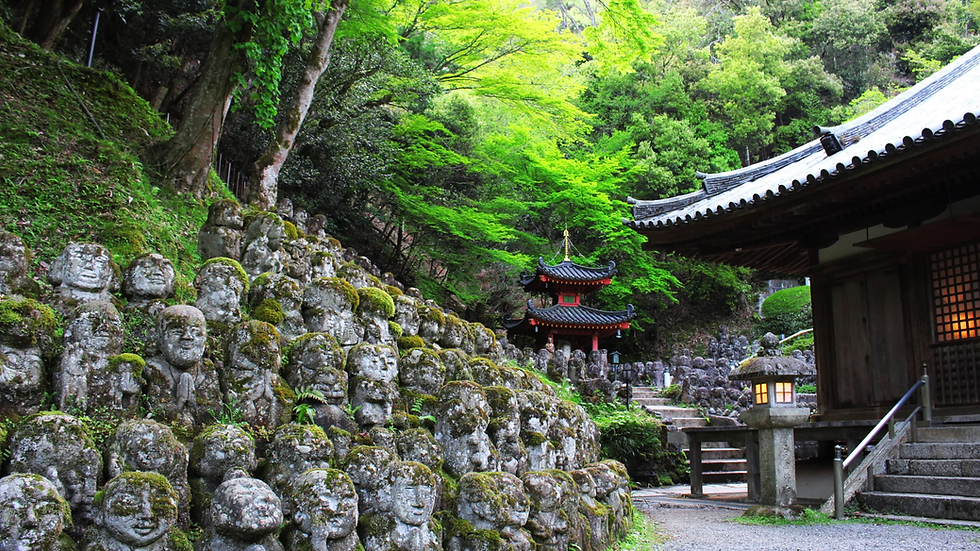
Embedded deep within western Kyoto, beyond the bustling Arashiyama district where the city dissolves into foothills, Otagi Nenbutsu-ji rests on a quiet slope shaped by forest, stream, and stone. Despite its proximity to one of Kyoto’s busiest neighborhoods, the temple remains discreet — a site marked by centuries of upheaval, devotion, and renewal.
Its origins reach back to 766, when tradition holds that Prince Shōtoku ordered the founding of Ōtagi-dera in the Higashiyama mountains, near what would later become Gion. Built in an age when spiritual centers lined the Kamo River basin, the temple stood only briefly; early Heian-period floods soon erased it.
Many centuries later, the Tendai priest Senkan Naigu reconstructed the temple and enshrined a new statue — Yaku-yoke Senju Kannon, the Thousand-Armed Kannon believed to ward off misfortune. According to temple lore, Senkan carved the figure himself, shaping raw timber as an act of devotion. His rebuilding restored the temple’s spiritual presence, though the region’s severe rains and shifting terrain again tested its endurance.
During the Kamakura period (1185–1333), the temple rose once more. This iteration introduced the current principal Buddha statue, distinguished by its asymmetrical eyes —interpreted by monks as reflecting two modes of mercy: stern and gentle.
In 1922, Ōtagi-dera was moved to its present location on a hillside in Arashiyama. Yet storms, typhoons, and Kyoto’s demanding climate continued to influence its fate, keeping the temple in a recurring cycle of vulnerability and renewal.
Kocho Nishimura and the Great Rebirth

The modern revival of Otagi Nenbutsu-ji began in 1955, when sculptor-monk Kōchō Nishimura (1915–2003) became the temple's head priest. Rather than settling for preservation, Nishimura envisioned a complete renewal shaped through communal artistic effort.
In 1981, he launched a decade-long project inviting people from across Japan to carve statues of rakan (Arhats), the Buddha's disciples revered for discipline and enlightenment. Nishimura taught pilgrims the fundamentals of stone carving and encouraged unfiltered creativity. The goal was not precision but sincerity — each participant carving the rakan they believed waited within the stone.

Today, the hillside is lined with 1,200 moss-covered stone figures. Some lift their faces skyward in jubilation. Others kneel in meditation. A few clutch cameras, instruments, or small objects that reveal the interests of the hands that carved them. What began as restoration has become a rare fusion of folk carving, personal expression, and spiritual imagination.
Nishimura’s descendants carry this vision forward. His sons and grandsons — now Buddhist priests — integrate music, photography, and film into inherited ritual, giving the temple a character shaped by daily devotion and an evolving artistic lineage.
A Retreat on the Edge of Arashiyama

Although close to Arashiyama’s bamboo grove, Otagi Nenbutsu-ji remains one of Kyoto’s quieter sanctuaries. Few visitors reach it, and those who do often feel the atmosphere shift as soon as they step inside. Stone faces rise from moss and undergrowth. Light moves across carvings that appear joyful, contemplative, or eerily still. The hillside becomes a living tapestry— part sculpture garden, part forest shrine, and wholly shared memory.
This isn’t a typical Kyoto temple. It is a landscape shaped by human hands, weathered by nature, and rebuilt across centuries. Within this sanctuary, spiritual instinct, artistic expression, and deep history meet in a setting that feels both cinematic and grounded.
In a city formed through ritual, Otagi Nenbutsu-ji stands apart — not as a grand monument but as a hillside story carved into stone, shaped by everyday hands into an uncommon vision. It invites each visitor to move with intent, to linger, and to see how art, belief, and memory leave their mark long after their creators are gone.
MK Take
Otagi Nenbutsu-ji isn’t just a temple — it’s a hillside story carved in stone, where local creativity and ancient spiritual traditions come together in a setting that feels both intimate and otherworldly. Kyoto has many temples, but few offer this blend of peaceful atmosphere, artistic spontaneity, and the sensation of wandering through a living forest of stories.

Let MK Guide You beyond Arashiyama’s crowds and into Kyoto’s western hills, where quiet slopes and moss-covered carvings reveal a side of the city many travelers never encounter.
M.R. Lucas is a writer living in Japan.
Image Credits
Official site of Otagi Nenbutsu-ji Otagi Nenbutsu-ji Temple, official website — © Otagi-ji (https://www.otagiji.com/)
Wikimedia Commons (CC BY 4.0)Thomas Housieaux, CC BY 4.0https://creativecommons.org/licenses/by/4.0, via Wikimedia Commons


